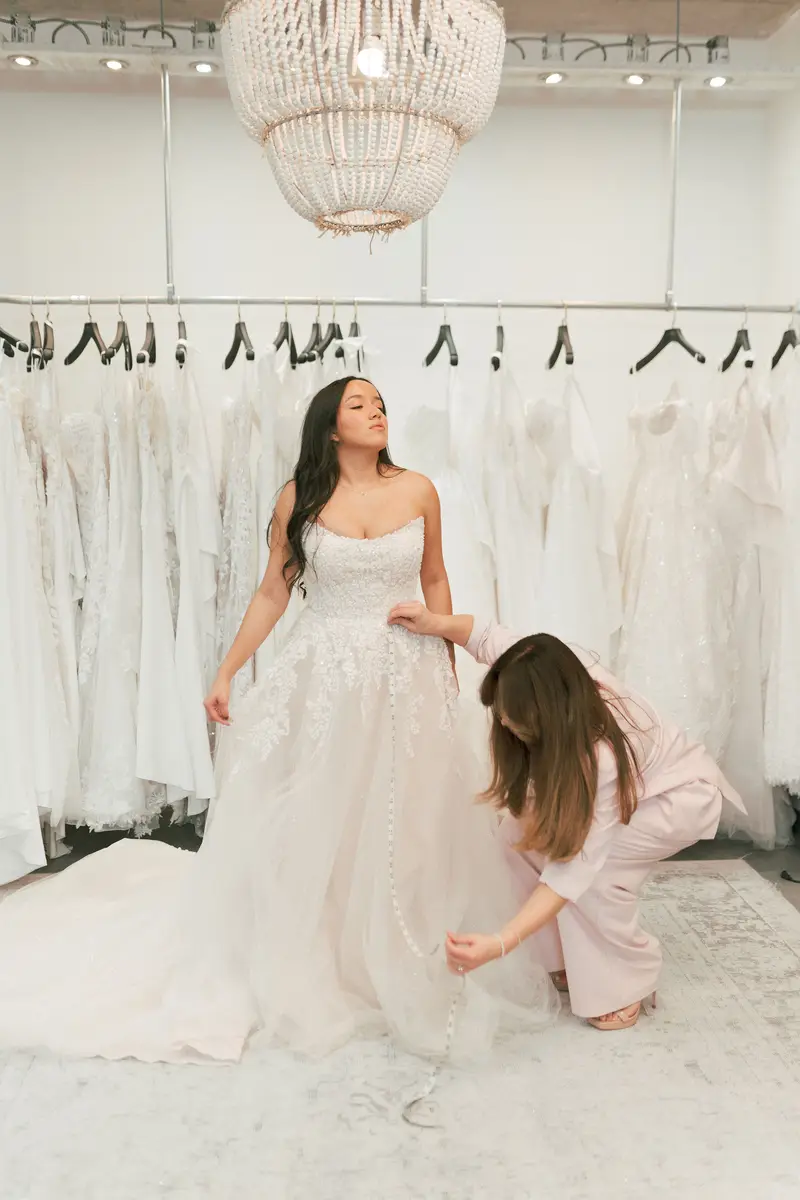
A stylist fastening the back of a gown for a bride during an appointment at Cande Bridal Boutique in Kelowna, British Columbia
Appointments and booking

A bride books herself, and the database refuses to sell the same slot twice

Public self-service booking, availability computed from your own rules, and capacity enforced inside the database rather than hoped for in the application.

12
open slots returned by the live booking page in the production run
3,820
appointments migrated off Bridal Web Solutions
100
emails delivered in production, with real Resend message ids

What does RingUps do about appointments?

RingUps books bridal appointments. A bride books herself on the store's own public booking page, or a staff member books her at the counter, and both land in the same appointment book. Availability is computed from the store's rules at the moment she asks. Capacity is enforced inside the database, so the same slot cannot be handed to two brides.

The shape of the record

Why a bridal appointment is not a thirty-minute meeting

A generic scheduler books a person for a length of time. That is not what a bridal store is selling. Five things sit inside a bridal appointment, and every one of them changes what the store can honestly offer.

A room
The appointment occupies a fitting room for its whole length, not just somebody's diary. Two consultants free at 10:00 is not two open appointments if there is one room free.
A stylist
The record carries the consultant running it, so the day reads as who is on what rather than as a column of times. It is also what makes a handover possible when the person who took the booking is off.
A party size
She is not arriving alone. Six people in a room built for three is a different appointment from the same ninety minutes with her mother, and the staff need to know which one is walking through the door.
A duration that depends on the type
A first appointment is not a second appointment. Each appointment type carries its own length, and that length is what availability is computed against, so a shorter type does not quietly consume a first-appointment slot.
A weekday that is not worth what every other weekday is worth
Saturday morning is the most valuable inventory a bridal store owns. Tuesday afternoon is close to free. The booking rules are written per appointment type per weekday for exactly that reason, so a Saturday can be reserved for consultations while a Tuesday takes whatever comes.
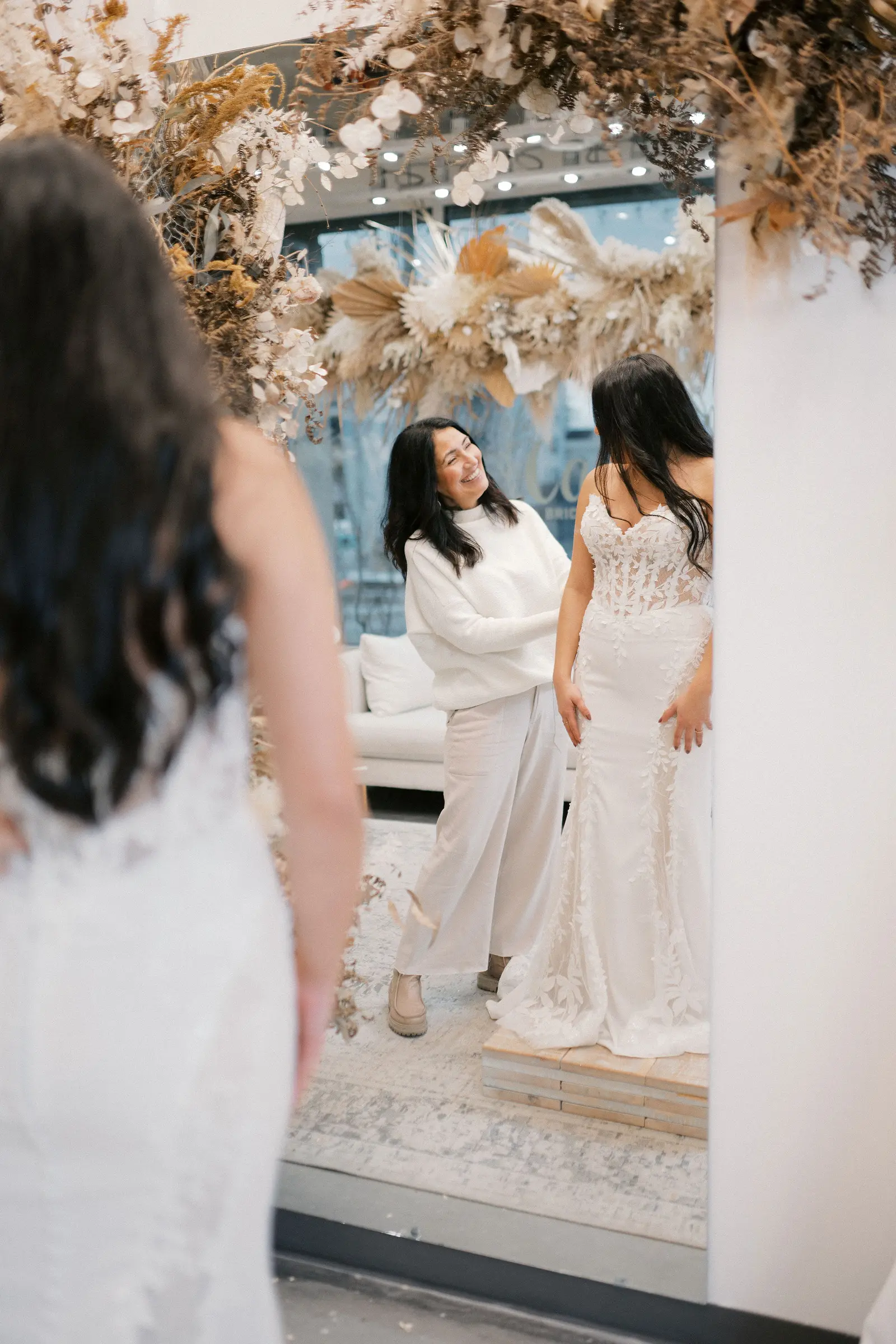
A bride being fitted into a gown by a consultant during a booked appointment at Cande Bridal Boutique
A ninety-minute first appointment at Cande Bridal Boutique. The room, the consultant and the length are all part of the booking, not notes beside it.

How does RingUps work out which appointment times are open?

It computes them at the moment she asks. RingUps does not create rows of empty appointments in advance and then hand them out. There is no calendar to generate, no month to open up, and no stale slot left behind when you change your mind about Saturdays.

That distinction sounds academic until you shorten your Saturday. In a system built on pre-generated slots, the empty rows already exist and someone has to go and delete them. In RingUps the rule changes and every future Saturday changes with it, including the one a bride is looking at on her phone right now.

What goes into a computed open time
InputWhere it comes fromWhat it does to the times she sees
Hours for the appointment typeThe booking rules you write, per type, per weekdayA first appointment can open at 09:30 on a Saturday and not run at all on a Tuesday
Duration of the typeThe appointment type itselfA first appointment and a second appointment reserve different amounts of the day
Capacity for that dayHow much the store can actually run at onceOnce the day is full, no further slot is offered, whoever is asking
Date-specific closuresDates you closeA buying trip removes the whole week without touching the weekly rules
Statutory holidaysA holiday table of 20 rows, Canada-wide plus British Columbia, covering 2026 and 2027Those dates return nothing, without anyone remembering to block them
Appointments already bookedThe appointment book itselfEvery confirmed booking reduces what the next visitor is offered, in the same request
The guarantee

What stops two brides booking the same slot in the same second?

Two brides, two phones, the same 10:00 on the same Saturday, half a second apart. This is the failure a store actually fears, because nobody finds out on the day it happens. Somebody finds out three weeks later, standing in the doorway with four guests, being told there has been a mistake.

Most booking software checks and then writes. It asks whether 10:00 is free, is told yes, and then inserts the row. Those are two separate trips, and there is a gap between them. If a second request arrives inside that gap, it is also told yes, and now two people hold the same room.

Step one

The booking is made by the database, not by the website

One function inside the database does the counting and the writing. There is no version of this that runs in the browser or in a server the store does not control, so there is no second path that could skip the check.

Step two

It takes a lock on that day before it counts anything

An advisory lock, held per day. While one booking for Saturday is being decided, a second booking for Saturday waits. Sunday is untouched, so a busy store is not serialised behind one queue.

Step three

The second request recounts and is refused

It waits milliseconds, then counts again against the booking that was just made, finds no room left, and is declined on the spot. The refusal happens in the same place the row would have been written, so there is no window between the two.

The same guarantee holds whether both requests came from two brides on the public booking page, or from a bride online and a staff member on the phone at the same moment.

This is the part most scheduling tools cannot say. Capacity that is enforced in application code is enforced only as long as there is one copy of that code running and nobody ever books from anywhere else. Capacity that is enforced by the database is enforced for every path into it, permanently, including the ones nobody has written yet.

End to end

From the link in her hand to the appointment in your book

Seven steps. What the store does is on the left of each one, what RingUps does is on the right. This sequence has run end to end in production against Cande Bridal Boutique's real booking page.

  1. You publish the booking link

    The store gets a public booking page of its own. It goes in the Instagram profile, the Google listing and the bottom of every email. Nothing behind it needs a login.

  2. She chooses an appointment type

    A first appointment and a second appointment are different types with different lengths. The type she picks is what the next step is computed against, so she is never offered a ninety-minute slot for a twenty-minute visit.

  3. RingUps computes the open times

    Hours for that type on that weekday, minus closures, minus statutory holidays, minus what is already booked against the day's capacity. In the production run the page returned 12 open slots, computed for that request rather than looked up.

  4. She picks a time and gives her details

    Name, email, the date of the wedding, how many people she is bringing. Party size arrives with the booking rather than as a surprise on the day.

  5. The booking function runs inside the database

    It takes the advisory lock on that day, counts what is booked, and either writes the appointment or refuses it. If two requests arrive together, exactly one of them wins, and the other is told immediately rather than three weeks later.

  6. The confirmation goes out by email

    Through the same email pipeline that has delivered 100 messages in production with real Resend message ids. Every send is logged on her record, and so is every message the system held back, with the reason in plain English.

  7. It appears in the appointment book

    On the day view, with the room, the consultant, the type and the party size, next to everything the counter booked by hand. There is one book, not a staff calendar and a website calendar that have to be reconciled on a Friday night.

The appointment book

What a Saturday looks like on the floor

One day view. Booked online and booked at the counter sit in the same list, because they are the same kind of record.

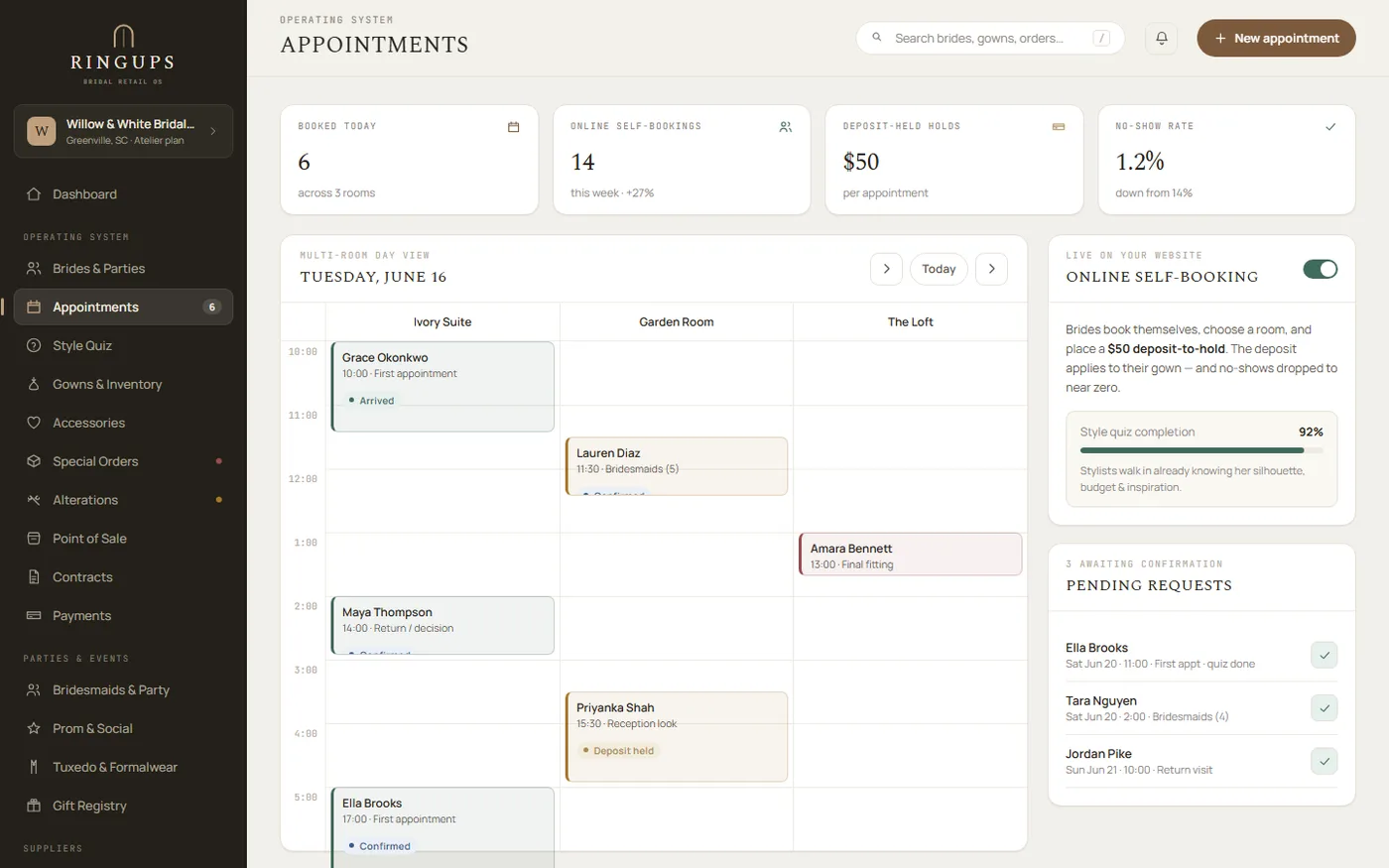
The RingUps appointments screen: a multi-room day view for Tuesday, June 16 with named bookings across the Ivory Suite, Garden Room and The Loft, summary tiles for bookings today, online self-bookings, deposit-held holds and no-show rate, and a pending-requests queue of online bookings awaiting confirmation
The live appointment book: three rooms, named bookings, deposit status and the online self-booking queue on one screen.
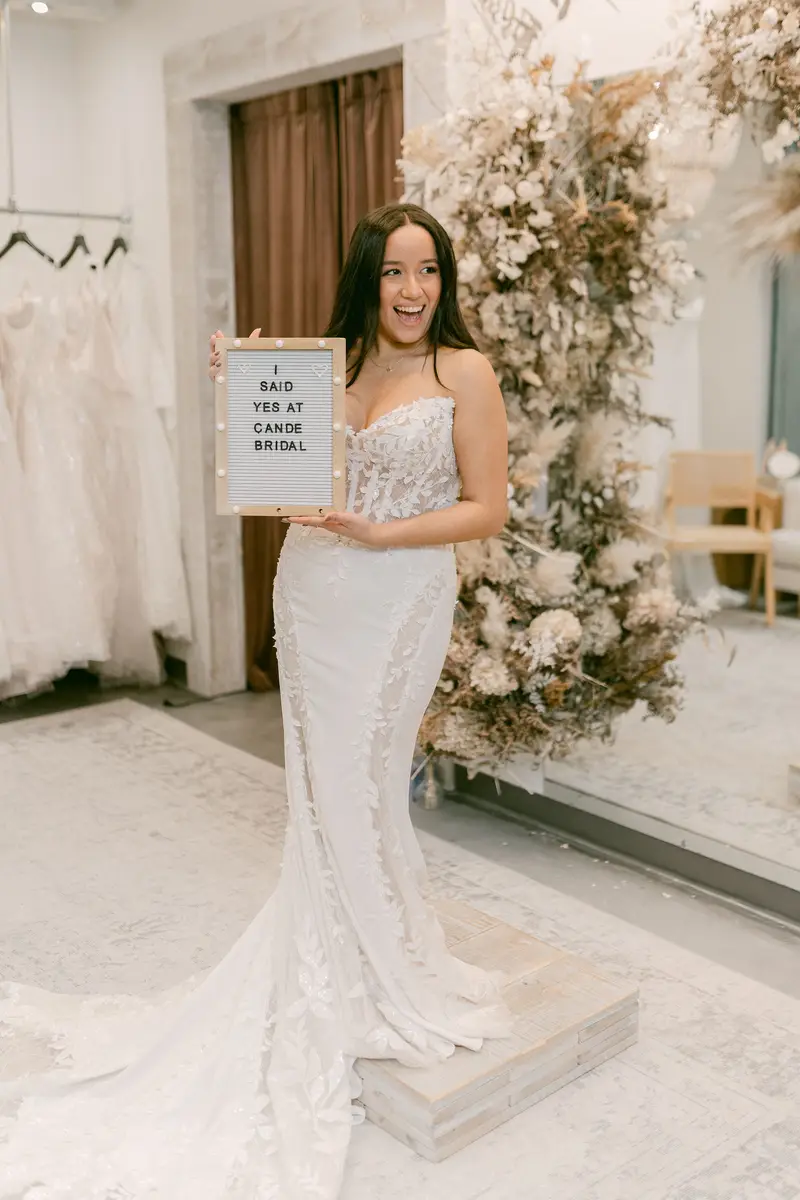
A bride's face at the moment she says yes to a gown at Cande Bridal Boutique
Proof, not promise

A real booking, taken by a stranger, verified in the database

Public self-service booking is not a screen we have designed. It ran end to end in production. The booking page returned 12 open slots, a booking was confirmed, and the row it created was checked in the database afterwards. That is the whole claim, and it is the whole evidence for it.

12
open slots returned by the live page, computed rather than stored
1
booking confirmed, and the row verified afterwards
3,820
historical appointments migrated off Bridal Web Solutions into that same book

The migration figure is a migration figure. Cande Bridal Boutique has been trading since, so the live total is higher, and RingUps does not present one as the other.

What it replaces

What is running your diary today, and what breaks about it

The four things a bridal store usually books with
What runs it todayWhat goes wrongWhat RingUps does instead
The paper book at the front deskOne person can read it, in one building, one page at a time. Nobody at home on a Sunday can answer a bride.The book is a database. The floor, the workroom and the owner read the same day view.
A general online scheduler bolted on the sideIt books a person for a length of time. It does not know about a fitting room, a party of six, or a first appointment that runs ninety minutes.Appointment types carry their own duration and count against the store's own capacity, room and consultant included.
The direct-message inboxShe asks at 11pm. Somebody answers at 10am. By then she has booked with the store that let her book at 11pm.She books herself, and every time she is offered is a time the store can genuinely take.
The person who keeps Saturday in their headThe rules are real but unwritten, so they leave with the person on the day they are off sick.The rules are written once and applied identically to every request, whoever is on the floor.

How does a bridal boutique take appointments online without double-booking a fitting room?

Most independent boutiques take bookings three ways at once: the paper book at the desk, direct messages on Instagram, and whatever their store system offers. BridalLive and Bridal Web Solutions both keep a scheduler, and both are perfectly capable of holding an appointment. The risk is rarely the scheduler itself. It is that the store is booking from more than one place and reconciling them by memory.

The safe shape is one book with one gate in front of it. Every path into the diary, whether that is a bride on her phone at 11pm or a consultant on the phone at the counter, goes through the same function, and that function is the only thing allowed to write an appointment. If the check and the write happen in one place inside the database, holding a lock on the day, the race that produces two brides in one room stops being possible rather than becoming unlikely.

That is how RingUps is built, and it is how Cande Bridal Boutique in Kelowna, British Columbia runs its Saturdays. It is worth asking any system you are considering the plain version of the question: if two people click the same slot in the same second, which one gets it, and what stops the other.
Questions

What owners ask about booking

Can brides book themselves online with RingUps?

Yes. Public self-service booking ran end to end in production on Cande Bridal Boutique's booking page. The page returned 12 open slots, a booking was confirmed, and the resulting row was verified in the database. A bride chooses an appointment type, sees times computed from the store's own rules, and receives an email confirmation.

Can two people book the same appointment slot at the same time?

No. The booking is created by a function inside the database, and that function takes a lock on the day before it counts anything. Two requests arriving in the same second are handled one after the other. The second one recounts, finds no room left, and is refused, so there is no gap between checking and writing for a double booking to slip through.

How does RingUps decide which appointment times are open?

It computes them when she asks, rather than storing pre-generated empty slots. RingUps takes the hours for that appointment type on that weekday, removes closures and statutory holidays, subtracts what is already booked against the day's capacity, and returns what is left. Change your Saturday hours and every future Saturday changes with them.

Bring last Saturday's schedule to the demo

We will rebuild that day in RingUps on a call, write your booking rules in front of you, and try to book the same slot twice while you watch.

Book a fifteen-minute demo on your own data See pricing