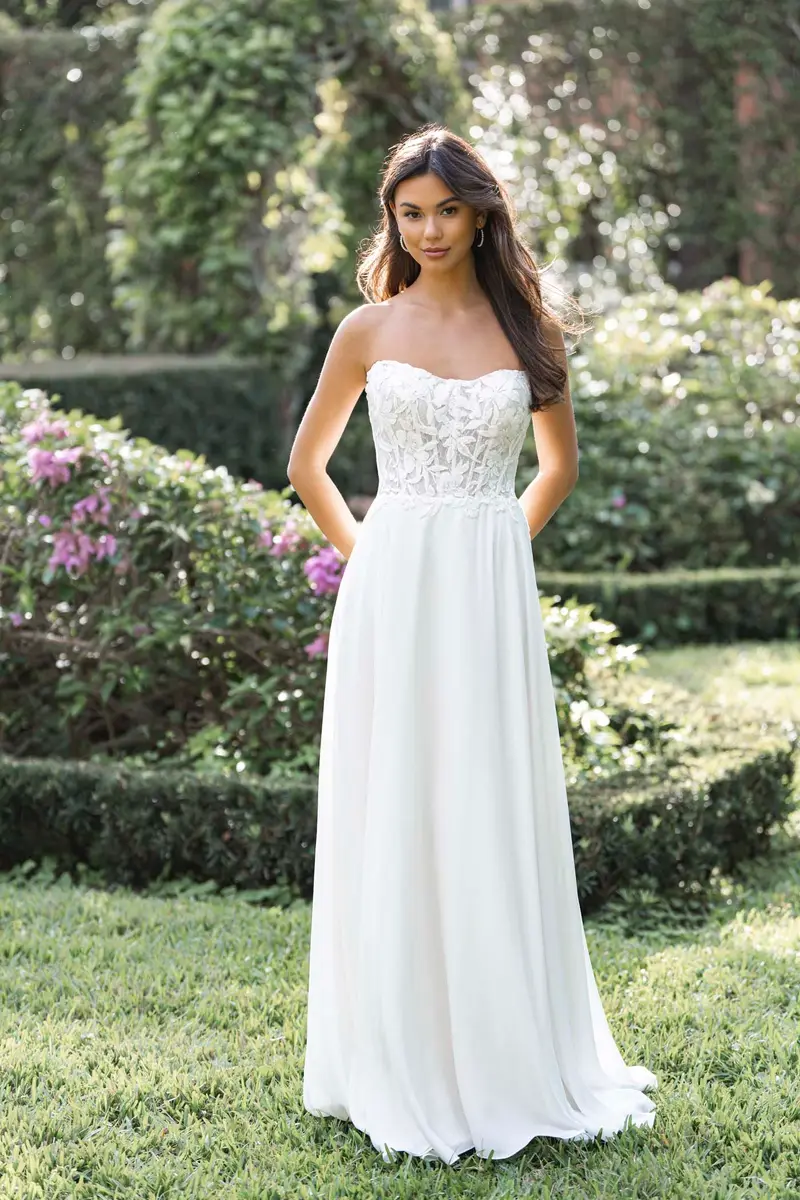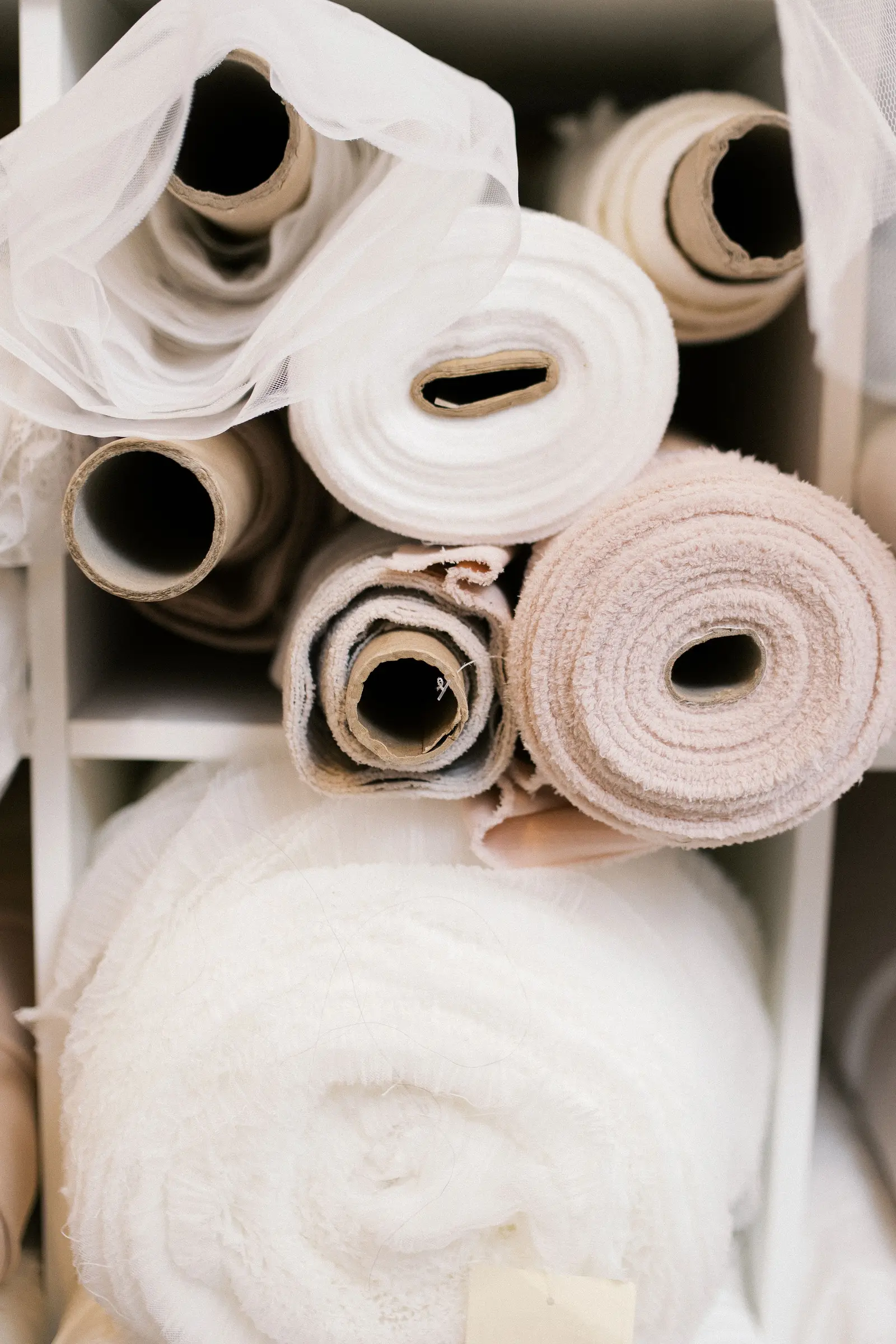
Ivory bridal fabric, lace and beading photographed in close detail at Cande Bridal Boutique in Kelowna, British Columbia

Special orders and designer management

Every special order is dated backward from the wedding, not forward from the sale

RingUps is bridal retail software that manages special orders, meaning the gowns a boutique buys from a designer for one named bride. It computes each gown's must-arrive-by date backward from the wedding date rather than forward from the order date, and it blocks a purchase order that would split a wedding party across two dye lots of the same fabric.

8
named pipeline stages on the ordering board, from order placed to order picked up
28 days
the alterations buffer the deadline engine subtracts by default
4
chase lists the board builds for you, including orders never placed with the designer

What does RingUps do about bridal special orders?

A special order is a gown that does not exist yet. The bride chooses it from a sample, the store buys it from the designer in her size and colour, and a mill somewhere cuts it. Between the sale and the wedding there is a production lead time nobody in the store controls, a shipping window nobody in the store controls, and an alterations window the store absolutely does control. RingUps holds all three against one fixed date, which is the wedding.

Two things on this page are enforced by the software rather than remembered by a person. The first is the deadline engine, which computes the date a gown has to be physically in the building and re-classifies every open order whenever a designer moves a ship date. The second is the dye-lot guard, which runs at the write path when a purchase order is placed and refuses the placement outright when it would split a wedding party across dye lots.

Everything else on the ordering board exists to make those two answerable at a glance. What that costs you is on the pricing page.
Three settings drive every date

Alterations buffer, in days
How long your workroom needs with a gown before the wedding. Subtracted from the wedding date to give the must-arrive-by date.
Fallback designer lead time
Used when a designer record carries no standard or rush lead time of its own, so a gown is never treated as instant.
Dye-lot guard, on or off
A store-level switch. With it on, a placement that would split a party across dye lots is refused unless a person ticks the override.
Allure Bridals style A1359 gown hanging on the sales floor at Cande Bridal Boutique
A sample on the floor. The gown the bride actually receives is cut months later, in a different size, from whatever fabric the mill has running.

The problem

Three ways a special order goes wrong, and none of them look wrong at the time

The gown that arrives too late to alter

It was ordered on time by every measure a general point-of-sale system understands. It shipped when the designer said it would. It simply landed inside the four weeks the workroom needed, and nobody did that arithmetic at the counter, because doing it means knowing the wedding date, the designer's lead time and your own alterations window at once.

The bridesmaid ordered on her own, three weeks later

Four of the five dresses went out together. The fifth girl paid late, so her dress was ordered separately, and by then the designer had moved to a new dye lot. Nobody notices until the party is standing in a row, which is usually the wedding day.

The order that was sold but never placed

A bride has paid a deposit and the gown is on a list somewhere, but no purchase order was ever raised with the designer. On a whiteboard or a spreadsheet this looks identical to an order that is progressing normally, because both of them look like a row.

The deadline engine

How does RingUps know when a gown has to arrive?

It starts at the wedding and works backward. The wedding date, minus the alterations window, gives the date the gown has to be in the building. Subtract the designer's shipping allowance and their production lead time from that, and you have the last day the purchase order can safely go out. A system that starts at the order date and adds weeks forward can only tell you when a gown will probably turn up. It cannot tell you whether that is soon enough.

The alterations buffer resolves in a fixed order of precedence: an override on the individual order first, then your store-wide setting, then a 28-day floor. Twenty-eight days is the rule Adriana Garcia set for Cande Bridal Boutique, and it is the number the engine has run on since.

A worked example. Saturday wedding, one gown, a designer whose record carries a fourteen-week standard lead time.
StepSubtractDateWhat this date is
Wedding date-Sat 12 Sep 2026The one date that does not move.
Less the alterations buffer28 days15 Aug 2026Must-arrive-by. The gown has to be physically in the store.
Less the shipping allowance10 days5 Aug 2026The date the designer has to have it out the door.
Less the production lead time14 weeks29 Apr 2026The last safe day to place the purchase order.

The lead time and shipping allowance above are illustrative. In use they come from each designer's own record, which holds a standard lead time, a rush lead time and the days that designer adds before a gown reaches you.

On track

The expected ship date lands before the must-arrive-by date, with the alterations window intact.

At risk

The ship date now lands after the must-arrive-by date. This also fires before placement, on the day the gown is sold, if the lead time already overshoots.

Past due

The date the designer promised has already gone by and the gown has not been checked in.

Needs wedding date

No wedding date is recorded, so no honest verdict exists. A confident green badge computed from a missing input is worse than no badge.

app.ringups.com/special-orders/new

Move the wedding date and watch the verdict change

The same arithmetic, live. Drag any of the three inputs. Dates are calculated from 4 August 2026.

Order inputs

Weeks until the wedding20 weeks
Designer lead time14 weeks
Your alterations buffer28 days

RingUps verdict

Safe to order
The gown lands with room for fittings. RingUps sets the must-arrive-by date on the purchase order and watches the ship date the designer gives against it.
Must arrive in-store byNov 24, 2026
Slack before it is at risk14 days
Order placed todayWedding day
Designer production Your alterations window

How it works

Five steps, from the sale to the box being opened

Each step names what the staff member does and what RingUps does in response. Nothing here runs on a person remembering to check something.

  1. 1

    Sell the gown and record the wedding date

    You do: write the order on the bride's record, with the style, size and colour. RingUps does: classifies the order immediately, before anything is placed with anyone. If the designer's lead time already overshoots the must-arrive-by date, the order is flagged at risk on the day it is sold, while there is still a conversation to have.

  2. 2

    Place the designer order

    You do: pick the designer, enter style, size, colour and dye lot, tick rush if it is a rush, and press one button. RingUps does: creates the purchase order and starts the lead clock against the must-arrive-by date. The printable purchase order is produced here, and you send it to the designer yourself.

  3. 3

    The dye-lot guard runs before anything is written

    You do: nothing, unless it fires. RingUps does: walks the wedding party attached to the order, looks for other gowns of the same catalogue style and colour that have not gone on order yet, and refuses the placement if it finds any. Nothing is saved. You either order the party together or tick the override.

  4. 4

    Record the designer's confirmation

    You do: when the designer writes back with a confirmation number and a real ship date, type it in. RingUps does: replaces the projected arrival with the designer's own date and re-runs the verdict on that order. If the new date no longer leaves room to alter, the order moves to at risk and onto the chase list the same moment.

  5. 5

    Check the gown in when the box is opened

    You do: mark the line received. RingUps does: when every special-order item on that bride's order has arrived, the whole order rolls up to arrived on its own, and it moves out of the ordering board and into the workroom queue.

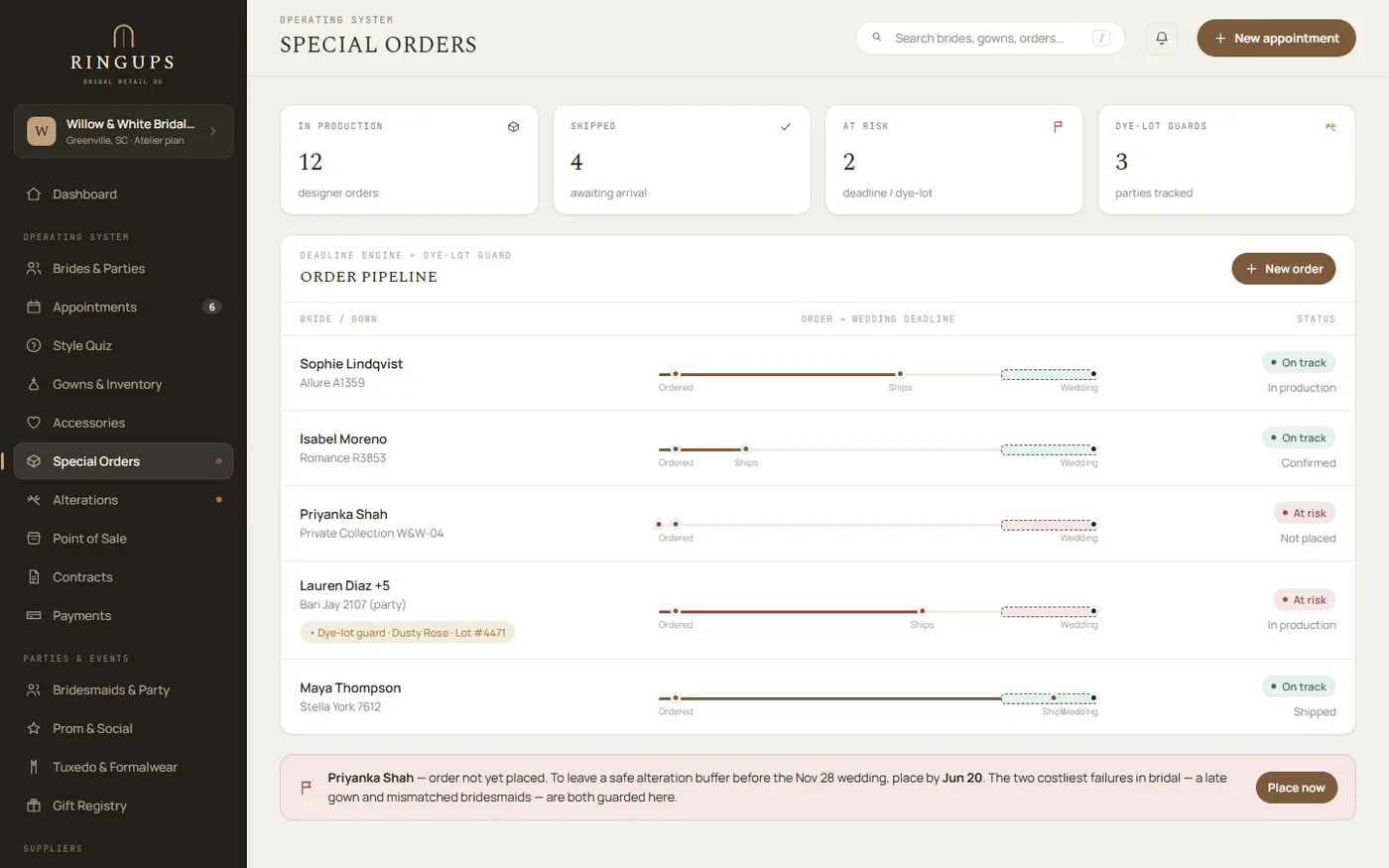
The RingUps ordering board showing open special orders sorted by risk, with past due, at risk, needs wedding date and on track states colour coded
The actual RingUps ordering board. The three ordering reports are built from this same query, so a download cannot disagree with what is on the screen.

Two gowns cut from different dye lots of the same fabric are not the same white. A bride and her bridesmaids in mismatched whites is a store's problem, not the mill's.

What is a dye lot, and why does it matter?

A dye lot is a single run of fabric coloured in one batch at the mill. Everything in that batch went through the same vat, in the same water, on the same day, so it is all exactly the same colour. The next batch is mixed again. It is called the same thing on the invoice, it is the same fabric from the same supplier, and it is a slightly different shade.

In most retail this does not matter, because nobody holds two garments up against each other. Bridal is the exception. Ivory, diamond white and champagne are not one colour each, they are a family of near-identical ones, and the eye cannot see the difference at all until the two are touching. Then it is the only thing anyone can see. It shows in every photograph of the party and it cannot be fixed by a seamstress, because the fabric is the wrong colour rather than the wrong shape.

The mill did nothing wrong. Neither did the designer, who will tell you, correctly, that dye lots vary and that gowns for one party should be ordered together. The mismatch is created in the store, at the moment somebody places one dress on its own because that girl paid late, or because a size was changed, or because the order was written three weeks after the others. By the time it is visible, the wedding is usually days away and the remedy is a conversation nobody wants to have.

This is a rule every experienced bridal manager already knows and no ordering system enforces. Which is the whole reason RingUps enforces it at the point of writing, rather than reporting on it afterwards.

Romance style R3853 gown photographed in natural light at Cande Bridal Boutique, showing the ivory tone of the fabric
One gown, one lot. The colour reads as simply ivory until a second gown from a different lot is standing next to it.

The dye-lot guard

The guard blocks the purchase order. It does not warn you afterwards.

When the guard is switched on for your store, the check runs before a single row is written. Placing a purchase order walks the wedding party attached to that order, finds every other live gown on the same catalogue style whose colour matches, and if any of them have not gone on order yet, the placement is refused. Not flagged. Refused, with the other names listed.

Then comes the honest part. RingUps does not yet put several gowns on one purchase order, so it cannot do the thing the error message is asking for. The only remedy available to a staff member today is the override checkbox: tick it, state that you meant it, and the order goes through. The value of the guard is that a person has to make that decision deliberately, on the day, rather than discovering it at the final fitting.

Scope, stated plainly. The block only fires on a gown that is a real catalogue style and is attached to a wedding party. A free-text line typed into an order, or a gown not linked to a party, is not guarded. There is also a separate watchlist on the ordering board that names any party whose gowns have ended up on different lots, or whose orders were written more than a month apart.

How designer lead times and catalogues are set up
app.ringups.com/ordering/place
Place designer order
Alvarez wedding party, 5 gowns
Placement blocked, error dye_lot

Two other gowns in this wedding party use style 3853 in ivory and have not been ordered yet. Ordering this one on its own risks a dye-lot mismatch. Order them together on one purchase order, or override.

R. Kim, bridesmaidnot yet ordered
T. Nguyen, bridesmaidnot yet ordered
J. Ford, bridesmaidon order, lot A-114
Override the dye-lot guard for this placement. I understand these gowns may arrive in different dye lots.

What this replaces, and what it was built on

A spreadsheet, a whiteboard and a general point-of-sale system can all record that a gown was ordered. None of them can answer the only question that matters, which is whether it still leaves enough time to alter. The special-orders module was built against a real store: Cande Bridal Boutique in Kelowna, British Columbia, whose entire order history came across from Bridal Web Solutions.

What each tool can answer about one open special order
QuestionSpreadsheet or whiteboardGeneral point-of-saleRingUps
Was this gown ordered?Yes, if somebody wrote the rowYesYes
When must it be in the building?Only if a person does the arithmeticNo, it has no alterations windowComputed backward from the wedding date
Does it still leave time to alter?NoNoOne of four states, re-run on every change
Did a ship date move?Only if somebody re-checkedRecords the new date, draws no conclusionEvery affected order is re-classified
Is this party about to split across dye lots?Only if a manager remembersDye lot is not a tracked fieldThe placement is refused at the write path
1,391

historical orders migrated into RingUps from Bridal Web Solutions, totalling $2,275,597.72, verified against production on 4 August 2026.

23 / 49

suppliers and designer divisions brought across with their lead times, alongside 625 catalogued styles and 624 of 625 products matched.

228

orders deliberately skipped during the migration rather than invent a bride to attach them to. Restraint is the proof, not the total.

Questions about special orders and dye lots

What is a dye lot, and why does it matter in a bridal store?

A dye lot is a single run of fabric coloured in one batch at the mill. Two bolts of the same fabric dyed in different lots are not the same white. The difference is small on its own and obvious when the gowns hang side by side. If a bride and her bridesmaids are ordered across two lots, the mismatch is the store's problem and not the mill's, and it usually surfaces on the wedding day when nothing can be done about it.

How does RingUps know when a gown has to arrive?

RingUps computes a must-arrive-by date backward from the wedding date rather than forward from the order date. It takes the wedding date and subtracts the alterations buffer, which is 28 days by default at Cande Bridal Boutique. The designer's production lead time and shipping allowance are then measured against that date, and the gown is classified as on track, at risk, past due, or needs wedding date.

What happens when the dye-lot guard blocks a purchase order?

The placement is refused before anything is written, and the message names the other gowns in the wedding party that share the style and colour. Because RingUps does not yet put several gowns on one purchase order, the only remedy today is to tick the override checkbox and place the order anyway. The block is a deliberate stop that makes a person decide, not a workflow that finishes the job for you.

Bring your riskiest open order to the demo

Book a fifteen-minute demo on your own data. Put one real open special order into RingUps, with its wedding date and its designer, and see which of the four states it lands in.

Book a demo See pricing