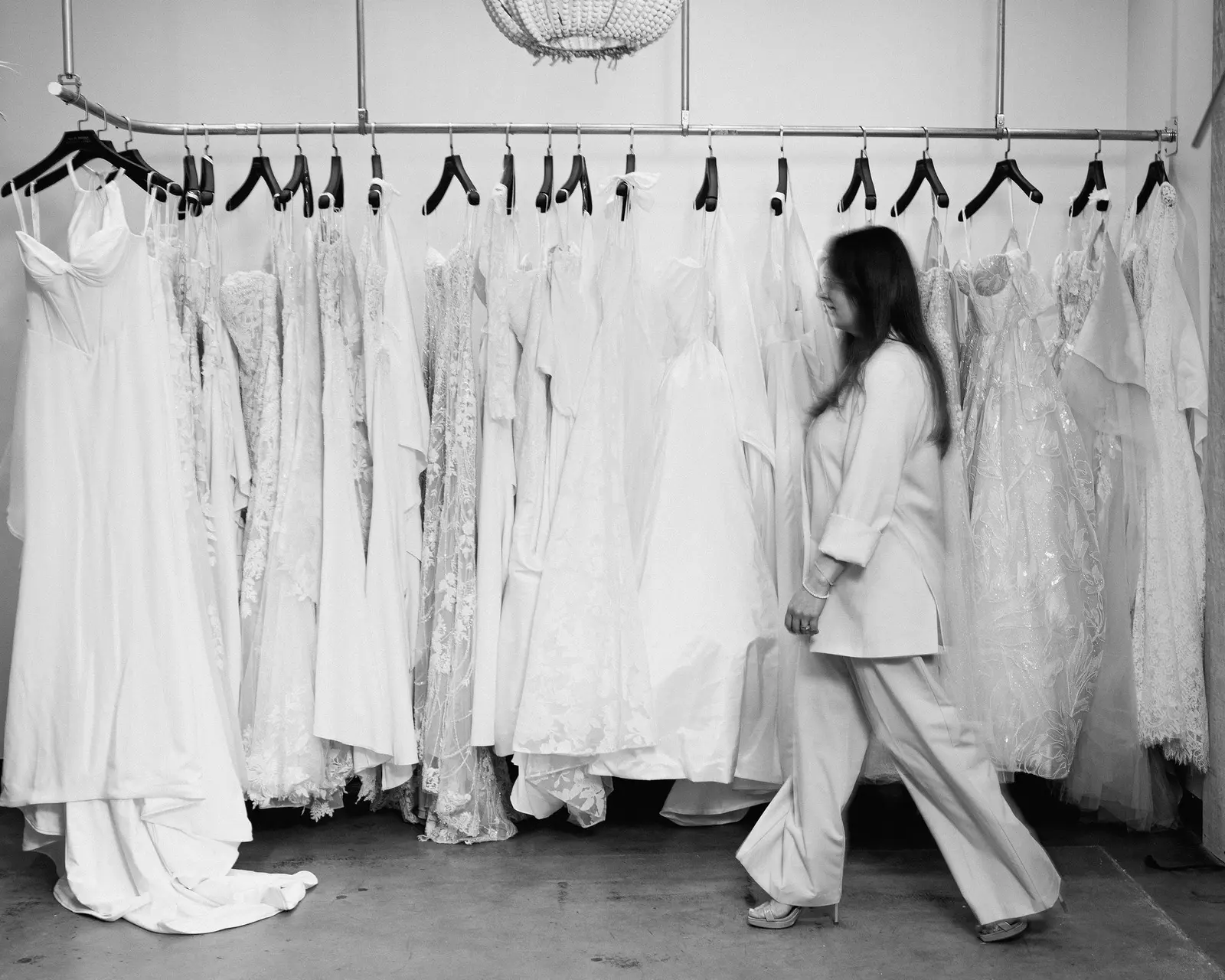
Adriana Garcia walking the sales floor at Cande Bridal Boutique in Kelowna, gowns hanging on the rail beside her
For groups with more than one shop

Every location in your group, one RingUps organisation

RingUps keeps a multi-shop group inside a single organisation instead of a separate account per shop. Every tenant table carries an organisation id and row-level security enforces it, so another store's data cannot appear in your queries. Nine operational tables, including the appointment book, floor inventory and orders, record which location the row belongs to.

9 tables
record which location a row belongs to, verified against the production database
1 login
granted against the organisation, not against one shop
$885
a month, what BridalLive's $295 per location charge costs three shops
The distinction that matters

Multi-tenant and multi-location are two different claims

Software vendors run these two words together, because one of them is much easier to build than the other. RingUps is genuinely multi-tenant, and that is provable. Multi-location is the second question, and it deserves its own answer rather than a borrowed one.

Multi-tenant

Many separate stores on one platform, walled off from each other

This is about strangers. A boutique in one province and a boutique in another both run on RingUps, and neither can see a single row belonging to the other. It is an architectural property, it is enforced by the database, and it is the same for every store on the platform whether it has one shop or six.

RingUps is this, and can show you why.

Multi-location

One business running several shops that wants to look across all of them

This is about you. It is a product question, not an isolation question: which screens carry a location filter, which numbers add up across shops, whether a manager can be held to one store. Strong tenant isolation is a precondition for it and is not the same as having it.

Structurally present. Walk through the specific screens with us.

How to test a vendor

Ask which of the two they have just described to you

A vendor answering "yes, we are multi-location" to a question about data separation, or answering "your data is isolated" to a question about a group report, has swapped one for the other. Ask both questions separately and write down both answers.

Ask us the same way. We would rather lose a deal than win it on a word.

Isolation

How is one store's data kept out of another store's queries?

Every tenant table in RingUps carries an organisation id, and which rows a session is allowed to read is decided by the database as part of answering the query. It is not a filter a developer has to remember to write into every screen, every export and every background job.

That distinction is the whole point. Application-level separation fails the day somebody writes one query without the filter, and the failure is silent: a report quietly containing somebody else's brides looks exactly like a report. Database-level separation cannot fail that way, because the careless query returns nothing rather than returning the wrong store.

The console RingUps runs the platform from sits outside that boundary and cannot read your brides. That is a trust proof about us, not a feature you receive, and it is worth saying in exactly those words.

Where a location is recorded and where it is not. Verified against the RingUps production database on 6 August 2026. Nine tables carry a location id; everything else is held once for the whole organisation.
RecordCarries a locationWhat that means for a group
AppointmentsYesAn appointment belongs to a shop. So do rooms, working hours, availability blocks, slot rules and the waitlist, which is what makes two diaries possible rather than one shared calendar.
Floor inventory unitsYesEach physical unit on the floor is stamped with the shop it is standing in. 502 units are recorded in production today, all at one location.
OrdersYesThe sale records where it was written, which is the column any per-shop revenue answer has to be built on.
Wedding partiesYesA bridal party is attached to the shop looking after it.
Bride recordsOrganisationOne bride, held once for the group. She is not duplicated per shop, and nothing stops a consultant at one shop opening her record.
Gown catalogueOrganisationStyles, designers and size charts are held once. A style added for the group is a style every shop can sell.
Payments and depositsOrganisationThe deposit ledger is one ledger for the business. Payments are tied to the order, and the order carries the location.
Designer purchase ordersOrganisationA purchase order belongs to the business rather than to a shop. If you buy per shop, raise it with us before you sign.
Staff, roles, permissionsOrganisationThis is the honest one. A permission is granted across the organisation, not scoped to one shop. There is no per-location permission today.
What goes wrong today

Two shops on two subscriptions is three jobs, not two

Most bridal software sells a second location as a second account. Each one is complete and neither knows the other exists, so the third job is the owner, on a Sunday, making the two agree.

The bride who exists twice

She books at the shop near her work and buys at the shop near her mother. In two accounts she is two records, with the appointment history in one and the deposit in the other, and whichever consultant opens the wrong one is the one who calls her about a gown she already bought.

The catalogue that drifts

The same designer is set up separately at each shop, so the style codes stop matching, the prices go out of step, and by the second season no report can add the two together without somebody mapping them by hand.

The month end that is two exports

Two systems produce two spreadsheets and the owner produces the third. At Cande Bridal Boutique we found a single system whose own exports disagreed with each other on one order. Two systems do not halve that problem.

The bill that multiplies quietly

Per-location charges are the ones nobody models before signing. The table further down this page multiplies out the one we have on record, because a group pays it once per shop and the arithmetic is the argument.

On the record

What a second shop looks like on a row

The location is not a label on a dashboard. It is a column on the row, written when the appointment is booked, when the unit is received onto the floor, and when the order is created. Anything you later want to ask per shop has to be answerable from that column, which is why it is worth checking that it exists before you check whether a chart is pretty.

The isolation and the location column are both in production now. What no page can honestly show you is a group in daily use, because there is not one yet.

How the rest of the platform is built →
Order 1247
Illustration of the record, not a screenshot
Location stamped
Organisationone per business
Locationwritten on the row
Brideheld once for the group
Floor unitlocation on the unit
Staff permissionorganisation-wide
Nine tables carry the location column. Staff, roles and permissions are not among them, so the last row is a limit rather than a setting.
An illustration of how a row is scoped, drawn from the production schema on 6 August 2026. Production holds one organisation trading and one location record.
Staff across shops

Can a manager be held to one shop, and what happens when staff work at both?

The good half first. Logins are personal and unlimited on every plan, so nobody shares a counter password across two shops, a departure is one revocation rather than a password change at both, and the audit trail carries a name. Who can see reports and who can see payments are separate switches per person, alongside four more for the training portal.

The honest half. Staff records, roles and permissions carry an organisation id and no location id. A permission therefore applies across the group rather than to one shop, so a manager you give report access to has report access for the business. If holding a manager to one location is a requirement for you, say so early: it is a change to the permission model, not a checkbox somebody forgot to tick.

Staff invites are also not emailed. The manager generates a link and forwards it, which matters more when the person is starting at your other shop on Saturday.

Every role and what it can see →
The team at Cande Bridal Boutique standing together on the sales floor
Reporting

What can a group owner actually get out of reporting?

RingUps ships 28 standalone report pages plus a hub, and 30 export keys, on every plan. Orders carry the location they were written at, which is the column a per-shop revenue answer has to be built from. Which reports present that column, and whether a particular comparison between your shops comes out of the box, is a question to answer in front of your own data rather than to assert here.

We would rather show you the screen than describe it. Bring a question you ask every Monday and we will answer it live or tell you it needs building.

28

report pages, plus a hub

With 30 export keys behind them. Every account gets all of them at the one flat rate; there is no tier to unlock.

3 of 1,403

imported orders name who sold them

And 8 of 3,851 imported appointments name a stylist. Sales-by-employee and closing rate are real reports running on near-empty history, so comparing consultants across shops starts the day you go live, not before it.

Pull-only

no scheduled or emailed reports

Nothing arrives in your inbox on Monday morning. You open RingUps and pull it. For an owner covering several shops that is a real inconvenience and we are not going to dress it up.

See the report list and its limits →

The arithmetic

A per-location charge is the one line a group pays several times

Our review of BridalLive recorded a charge of $295 per month, per location, applied where a store does not move to that vendor's payment processing. A single boutique reads that as an annoyance. A three-shop group pays it three times, and the number stops being an annoyance somewhere around the second shop.

RingUps takes no percentage of your sales and makes no charge for keeping the processor you already use. Read the table, then go and read your own agreement for the same clause before you compare anything else.

BridalLive's recorded $295 per month per location charge, multiplied out by shop count. The charge applies where a store does not move to that vendor's payment processing. Figures recorded in the RingUps review of BridalLive, 4 August 2026. RingUps has no equivalent charge.
Shops in the groupBridalLive, per monthBridalLive, per yearRingUps equivalent charge
1 shop$295$3,540None
2 shops$590$7,080None
3 shops$885$10,620None
4 shops$1,180$14,160None
5 shops$1,475$17,700None

Two things this table does not say. It is not a total cost of ownership comparison, because it is one line from one vendor's pricing and your invoice has other lines on it. And a charge you avoid is not the same as a capability you gain: in-app card processing is wired for Cande today and rolls out to new stores as Stripe Connect comes online, so a new shop keeps its existing terminal in the meantime and RingUps records the payment.

RingUps is one flat rate, $99 a month, CAD or USD depending on where the store sells, with every feature included and no tier to climb. There is no self-serve way to add a second location yet, so each shop in a group, including the first, is priced individually: ask, and we bring your next location online with you personally. Full pricing and the BridalLive comparison are both published.

Where to go next if you run more than one shop

Questions a group owner asks

Can RingUps run more than one location on one login?

One RingUps organisation can hold more than one location, and a person's login is granted against the organisation rather than against a single shop. Nine operational tables stamp the location on the row, including appointments, rooms, working hours, floor inventory units, orders and wedding parties. Whether a particular cross-location report or rollup exists is a question to put to us on a demo, not something to take on trust from a web page.

Is my data actually separate from another boutique's data?

Yes, and it is separated by the database rather than by application code remembering to add a filter. Every tenant table carries an organisation id and row-level security decides which rows a session may read, so one store's brides cannot appear in another store's queries even if a query is written carelessly. The RingUps-internal platform console is deliberately outside that boundary and cannot read your brides, which is a trust proof rather than a feature you receive.

What does BridalLive's $295 per location charge cost a group of three?

$885 a month, which is $10,620 a year. BridalLive applies $295 per month per location where a store does not move to its own payment processing, so a three-shop group pays it three times. RingUps charges no percentage of your sales and has no equivalent charge for keeping the processor you already use.

Bring your rollout plan, not just your questions

Tell us how many shops, on what systems, in what order. We will answer the cross-location questions on the screen, in front of your own data, and tell you plainly which ones need building.