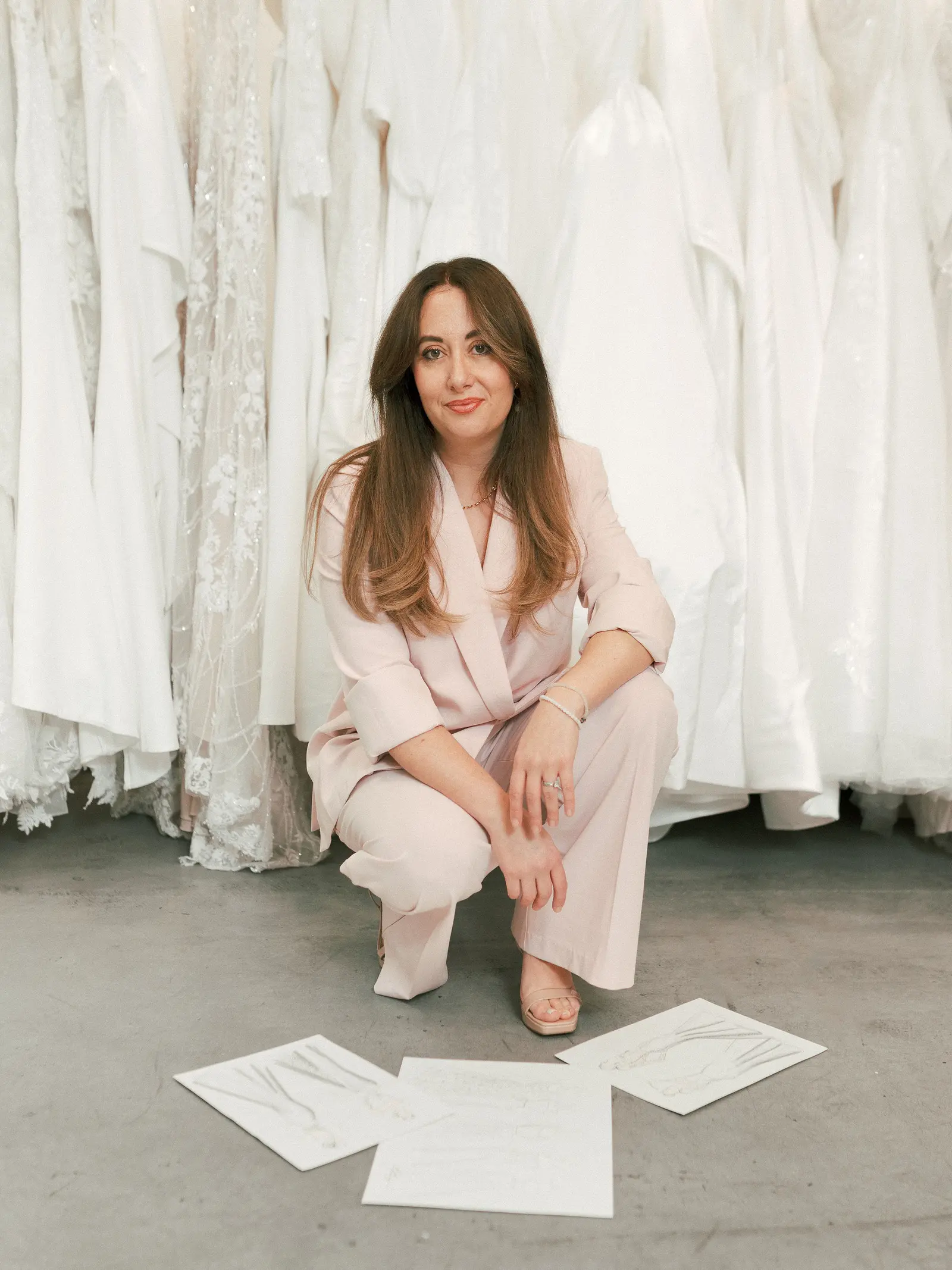
Adriana Garcia working through gown design sketches at Cande Bridal Boutique in Kelowna, British Columbia

Drafting and automation

Turn a gown photo into catalogue data, and a blank page into a training course

Photograph a gown and RingUps drafts its silhouette, neckline, sleeve, waistline and fabric as attributes your staff accept or reject in seconds. Describe a training course and get a first draft written for you, ready to edit and publish. A person reviews every draft before anything is saved, and nothing in RingUps sends a message, prices a gown or commits a deadline on its own.

Both features are off until an Anthropic API key is provisioned for your store.

2
places in the whole product where a language model is called at all
610 of 730
gown rows in a real migrated catalogue that carry no product name at all
0
messages either feature sends. Both produce a draft and stop there

What does RingUps actually use AI for?

Two things, and they are both drafting jobs. RingUps will write a first draft of a staff training course from a description you type, and it will read a photograph of a gown and propose the catalogue attributes that gown has. That is the entire list. There is no third feature waiting behind a toggle and no fourth one in a slide deck.

The distinction that matters is between a drafting tool and a decision tool. A drafting tool gets you off a blank page and then hands the work to a person. A decision tool acts. Everything on this page is the first kind. The training draft is text nobody has published yet. The gown attributes are chips a staff member accepts or rejects one at a time, and nothing reaches the catalogue until someone accepts it.

This is a category where overclaiming is normal, so it is worth being exact. No model in RingUps writes to a bride, sets a price, commits a delivery date, approves a discount or decides which gown to show. Those are either done by a person or computed by arithmetic, and the section below sets out which is which, line by line.

The complete list, both live

Training course first drafts
Describe the course you wish your staff had already taken and RingUps drafts it. The draft stays a draft until a named person on your team signs it off.
Needs an Anthropic API key
Gown attributes from a photograph
Give it a photograph of the gown and it proposes silhouette, neckline, sleeve, waistline and fabric as chips. A staff member accepts or rejects each one.
Needs an Anthropic API key
Everything else in RingUps
Rules, arithmetic and database checks. Deterministic, auditable, and unaffected by whether you ever provision a key.
Close detail of ivory bridal fabric, lace and beading at Cande Bridal Boutique in Kelowna, British Columbia
Lace over tulle, or lace over organza, or a beaded net that photographs like both. Somebody has to write that down for every style on the floor.

The problem

Why is bridal catalogue data always this bad?

Because entering it is nobody's job. A gown arrives, it goes on the floor, it gets sold. The silhouette, the neckline, the sleeve, the waistline and the fabric are all obvious to anyone standing in front of the dress, which is exactly why nobody stops to type them into a system. The catalogue fills up with rows that a human can identify at a glance and a computer cannot identify at all.

This is measurable, not anecdotal. In the catalogue migrated into RingUps from Bridal Web Solutions for Cande Bridal Boutique, 610 of 730 product rows carry no product name whatsoever. That is not a Cande problem and it is not a Bridal Web Solutions problem. It is what happens to any catalogue that depends on someone finding a spare afternoon.

What that costs on the floor

A bride says strapless, A-line, lace at the top, nothing too sparkly. If those attributes were never recorded, no search can answer her, and a consultant walks the rack from memory. RingUps builds catalogue search on designer, style number and attributes rather than on gown names, precisely because the names are mostly empty. See the catalogue page for how that search is put together.

AI feature one

How does the gown attribute reader work?

Four steps. Each one names what the staff member does and what RingUps does in response. Note where the writing happens, which is step four, and note who does it.

  1. 1

    Photograph the gown

    You do: photograph the sample on your own floor, or use the designer's product shot if you have one. RingUps does: nothing yet. The image sits on the style record as an image.

  2. 2

    Ask for a read

    You do: press the button on the style record. RingUps does: sends that photograph to Anthropic's API using the key provisioned for your store, and asks for the attributes as structured fields. Without a key this button does nothing, and says so.

  3. 3

    Read the suggestions as chips

    You do: look at what came back. RingUps does: shows silhouette, neckline, sleeve, waistline and fabric as separate chips rather than as one block you have to take or leave. Fabric is always flagged as worth checking, because a photograph cannot honestly tell you what a fabric is.

  4. 4

    Accept, correct or reject each one

    You do: accept the ones that are right, fix the ones that are close, reject the rest. RingUps does: writes only what you accepted. A suggestion nobody touched is not catalogue data, and it is not treated as any.

app.ringups.com/catalogue/style
Attributes drafted from the photograph
Nothing saved yet
Silhouette  A-lineaccept / reject
Neckline  Off-shoulderaccept / reject
Sleeve  Detachableaccept / reject
Waistline  Naturalaccept / reject
Fabric  Lace over tullecheck this one

Illustrative values. Each chip is accepted or rejected on its own, so a wrong neckline does not cost you the correct silhouette.

What this replaces is the afternoon nobody has: a person with a clipboard walking the floor, opening each style record and typing five fields per gown. The reader does not remove the person. It moves them from typing to checking, which is a job that can actually be finished between appointments.

AI feature two

It writes the staff training you never get around to writing

Every owner has a list of things a new consultant ought to know and no time to write any of it down. RingUps takes a description of the course you want and produces a first draft of it inside the training portal, which is a real part of the product rather than a document you email around.

Then it stops. The draft is unapproved and marked as unapproved. Somebody on your team reads it, rewrites the half of it that describes a store other than yours, deletes what is wrong and publishes what is left. A model that has never met your brides cannot write your fitting policy, and RingUps does not behave as though it can.

The value is narrower than the marketing category suggests and it is real. Editing a bad first draft takes an evening. Writing from a blank page takes a quarter, which is why the course does not exist.

See the training portal and how courses are assigned
app.ringups.com/training/courses
Course draft, not published
Running a first fitting at our store
Awaiting a person
Section outlinedraft
Body textdraft
Your fitting policyyours to write
Approve and publish
Edit

Illustrative. Nothing is visible to a single member of staff until somebody presses approve, so you always know which words are yours.

Rules or AI

Which parts of RingUps are AI, and which parts are just rules?

Most software vendors are happy for you to assume the answer is all of it. The honest split is more useful, because it tells you which behaviours will give the same answer twice. The two automations a bridal store leans on hardest, the special-order deadline engine and the dye-lot guard, contain no model at all. They are arithmetic and a check.

That is a feature, not a shortfall. A must-arrive-by date has to be reproducible, explainable to a designer on the phone, and identical on the screen and in the export. A deterministic rule can be all three. A model cannot promise any of them.

Every automated behaviour on this page, and what is behind it
BehaviourWhat is behind itNeeds an API keySame inputs, same answer
Must-arrive-by date on a special orderArithmetic. The wedding date less the alterations buffer, then the designer's shipping allowance and production lead time measured against it.NoAlways
Dye-lot guard on a designer orderA deterministic check at the write path. It walks the wedding party, finds gowns on the same style and colour that have not gone on order, and refuses the placement.NoAlways
Why a message was held backRules. Every suppressed message carries a plain-English reason recorded against it.NoAlways
First draft of a training courseA language model, prompted with the description you typed. The output is an unapproved draft.YesNo, which is why a person approves it
Suggested gown attributes from a photographA language model reading the image. The output is chips on a form.YesNo, which is why a person accepts each chip

Three of the five are deterministic and keep working whether or not your store ever provisions a key. The special-order engine and the guard are covered in full on the special orders page.

A model that drafts a training course is useful. A model that decides when a gown has to arrive is a liability. RingUps only has the first kind.

The condition, stated up front

Neither AI feature works without an Anthropic API key for your store

This is not a footnote. Both features call Anthropic's API, and the key is provisioned per store rather than shared across every RingUps customer. Until your store has one, the training draft button and the gown attribute reader are inert. They do not degrade to something worse. They do nothing, and the interface says so.

The practical consequence is that you can run all of RingUps without ever turning either of them on. Appointments, orders, deadlines, the dye-lot guard, payments, reporting and email are untouched by this, because none of them call a model. The two AI features are additive, and they are the only part of the product with an external dependency of this kind.

Bring the key question to the demo. It is a short conversation and it is better had before you are relying on either feature than after.

With no key provisioned

No training drafts and no attribute suggestions. Courses are still written and assigned by hand, and gown attributes are still typed in by hand, which is how every store does it today.

Where your data goes

When you press either button, the photograph or the course description goes to Anthropic's API under your store's key. That is where the drafting happens. Security and trust and the privacy policy cover how data is handled everywhere else in RingUps.

Questions about AI in RingUps

Does RingUps use AI to write to my brides?

No. No message to a bride is written, sent or answered by a language model in RingUps. There is no bride-facing chatbot, no automatic reply and no drafted follow-up. RingUps sends email only, and the email it does send comes from templates your own store wrote and a person triggered.

What do I need before the AI features work in RingUps?

An Anthropic API key provisioned for your store. Until that key is in place, the training draft and the gown attribute reader do nothing at all. Every other automation in RingUps, including the special-order deadline engine and the dye-lot guard, runs without it, because neither of those calls a model.

What does the gown attribute reader actually give me back?

You give it a photograph of the gown and RingUps drafts the style's attributes: silhouette, neckline, sleeve, waistline and fabric, as chips a staff member accepts or rejects one at a time. Nothing is written to the catalogue until someone accepts it. Fabric is always flagged as worth checking, because a photograph cannot honestly tell you what a fabric is.

Is the special-order deadline engine AI?

No. The must-arrive-by date on a special order is arithmetic. RingUps subtracts the alterations buffer from the wedding date, then measures the designer's production lead time and shipping allowance against the result. The dye-lot guard is the same kind of thing, a deterministic check at the write path that refuses a purchase order placement outright. Neither calls a model, and both return the same answer every time from the same inputs.

Bring a gown photograph and a course you never wrote

Book a fifteen-minute demo on your own data. Photograph one gown off your floor and see what comes back, and ask the key question and the training question while you have someone on the call.

Book a demo See pricing